
Active claim
The plaintiff has an unresolved personal injury or civil claim.
Sacramento lawsuit loans provide non-recourse cash advances from $500 to $2,000,000 for plaintiffs waiting for compensation from pending personal injury and civil claims. Mayfair Legal Funding evaluates liability, documented damages, insurance coverage, defendant assets, attorney representation, existing liens, prior advances, expected case duration, and projected net proceeds.
Repayment comes from a successful settlement, judgment, award, or verdict. A funded Sacramento claim that produces no financial recovery creates no ordinary repayment obligation under the non-recourse agreement.
Sacramento lawsuit funding does not require a credit check, employment verification, income verification, personal collateral, or monthly installment payments. Claim value and expected recovery determine eligibility rather than the plaintiff’s personal borrowing history.
Mayfair Legal Funding helps Sacramento plaintiffs obtain pre-settlement cash for accident claims, personal injury lawsuits, employment disputes, malpractice claims, product liability cases, civil-rights actions, and wrongful-death claims.
Contact Mayfair Legal Funding for Sacramento lawsuit funding.
Mayfair Legal Funding reviews case evidence, medical damages, insurance limits, attorney records, liens, prior funding, settlement activity, and expected net compensation before approving an advance.

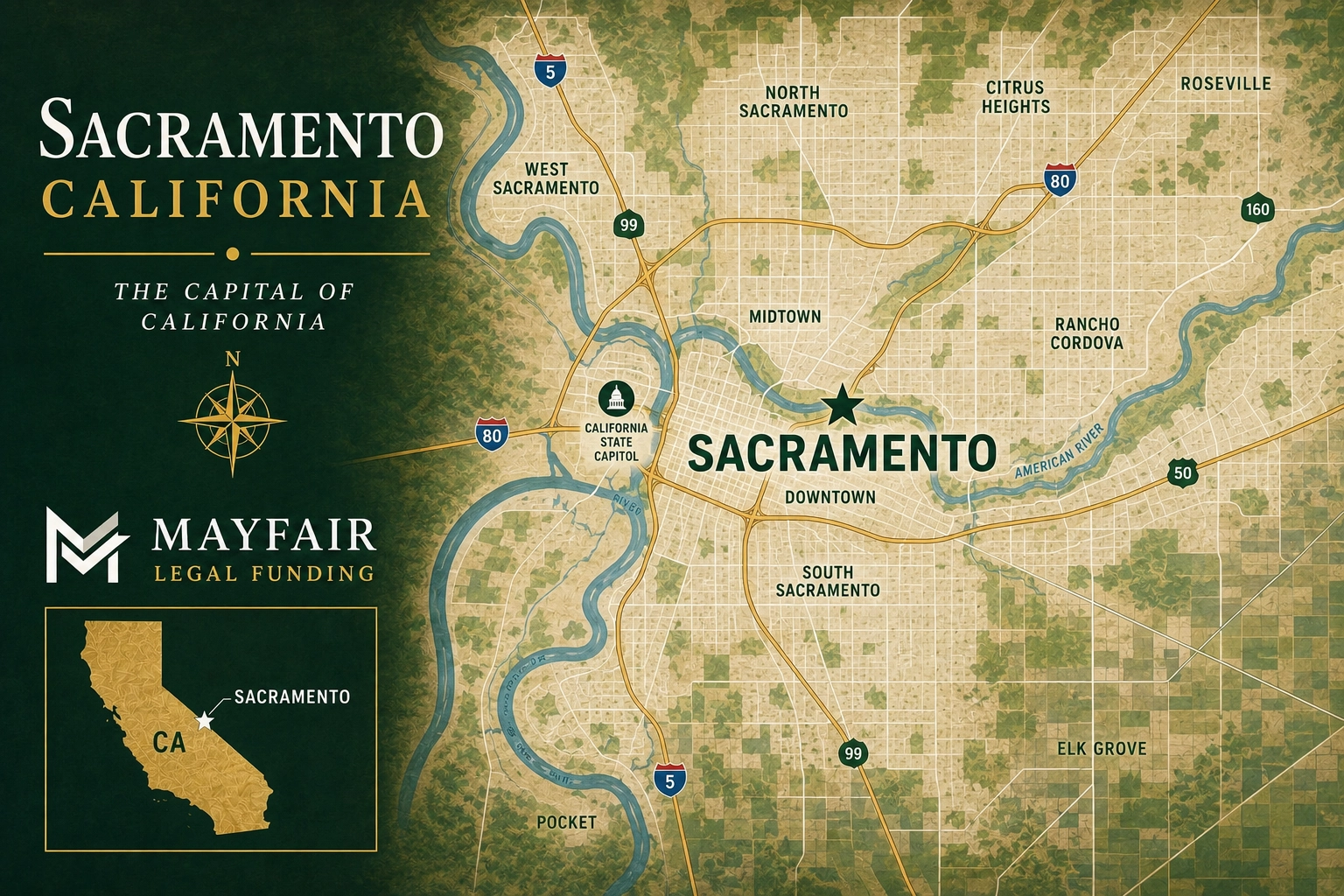
A Sacramento lawsuit loan is a non-recourse cash advance based on a contingent right to part of the plaintiff’s future legal recovery.
California law refers to this transaction as consumer legal funding. The funding agreement assigns a predetermined repayment amount against proceeds from a potential settlement, judgment, award, or verdict rather than creating a conventional personal loan.
Lawsuit loan, pre-settlement loan, settlement loan, plaintiff funding, legal funding, and lawsuit cash advance are common terms for this funding category.
Sacramento lawsuit funding converts part of the expected net value of a pending legal claim into cash before the case resolves.
The plaintiff submits case and attorney information. Mayfair Legal Funding coordinates with the retained attorney, evaluates liability and damages, identifies available insurance or other recovery sources, reviews liens and prior funding, and calculates whether the anticipated proceeds support the requested advance.
An approved plaintiff receives written terms identifying the advance, charges, repayment schedule, maximum repayment amount, cancellation rights, and attorney acknowledgement.
The attorney repays the agreed amount from successful claim proceeds after resolution. California law requires attorney acknowledgement and trust-account or settlement-fund handling of the proceeds.

A Sacramento lawsuit loan follows 4 direct steps from application to funding.
Provide the claim type, incident date, requested amount, attorney contact information, and current case status.
Authorize the attorney to provide liability evidence, treatment information, insurance details, settlement activity, liens, and other underwriting records.
Review the approved amount, periodic charges, 1-time charges, repayment schedule, maximum repayment amount, and cancellation provisions.
Completed and approved funding is distributed within 24 hours. Mayfair’s same-day funding process uses attorney review followed by agreement execution and electronic distribution.
Sacramento lawsuit funding requires a bona fide civil claim, contingency-fee attorney, supporting evidence, measurable damages, an identifiable recovery source, and sufficient expected net proceeds.
California consumer legal funding also requires the consumer to reside or be domiciled in California and to have an attorney working under a written contingency-fee agreement.
The 7 qualification factors are listed below:
Mayfair provides pre-settlement funding in 46 states. Explore your state to learn about local funding laws, typical timelines, and the types of cases we fund in your area.
No, Sacramento lawsuit funding does not depend on a credit score, current job, salary, or conventional debt-to-income calculation.
Mayfair Legal Funding evaluates the legal claim instead. Liability strength, damages, insurance coverage, medical treatment, liens, attorney assessment, expected resolution, and projected net compensation determine the funding decision.
A plaintiff unable to work because of an injury still receives a case-based review.
Sacramento plaintiffs receive lawsuit funding from $500 to $2,000,000 based on the expected net value of the legal claim.
Funding amounts depend on:
A large damage estimate does not automatically support a large advance. The expected proceeds remaining after senior deductions determine the amount available for funding.
A $150,000 expected Sacramento settlement does not produce a fixed advance because deductions change the plaintiff’s expected net recovery.
The table below shows an example funding-value calculation.
The $70,000 expected remainder forms a more useful underwriting figure than the $150,000 gross settlement.
Comparative fault, different liens, prior funding, policy limits, or higher case expenses produce a different result.
Sacramento lawsuit funding pays personal living and injury-related expenses during an unresolved legal claim.
Sacramento’s median gross rent was $1,779 during 2020–2024, and median monthly housing costs for homeowners with a mortgage were $2,380.
The 9 common uses are listed below:

Maintain housing during treatment or lost-income periods.
Cover personal treatment expenses, prescriptions, rehabilitation, therapy, and medical equipment.
Pay groceries and household food expenses.
Pay electricity, water, gas, phone, and internet bills.
Cover fuel, car payments, repairs, rideshare costs, or public transportation.
Pay childcare during treatment, recovery, attorney meetings, or court activity.
Maintain personal health, auto, renters, or other insurance obligations.
Address immediate personal bills and credit obligations.
Pay personal burial or funeral costs associated with a wrongful-death claim.
Sacramento lawsuit loans cover motor vehicle accidents, pedestrian and bicycle injuries, premises liability, workplace claims, malpractice, defective products, employment cases, public-entity claims, civil-rights actions, catastrophic injuries, and wrongful death.
Catastrophic claims involving brain injuries or spinal cord injuries receive underwriting based on liability, long-term treatment, disability, earning loss, insurance coverage, liens, and expected proceeds.
The table below shows major funding categories and their Sacramento context.
Car accident lawsuit loans
I-5, I-80, US-50, SR-99, Capital City Freeway, intersections, uninsured motorists, and multi-vehicle crashes
Interstate freight, commercial carriers, delivery vehicles, employers, maintenance companies, and cargo operators
Motorcycle accident lawsuit loans
Unsafe turns, lane changes, speeding, failure to yield, impaired driving, and road hazards
Bicycle accident lawsuit loans
Bike lanes, intersections, dooring, unsafe turns, right-of-way disputes, and roadway conditions
Pedestrian accident lawsuit loans
Crosswalks, arterial streets, transit areas, downtown streets, school areas, and unsafe turns
SacRT buses, private coaches, school buses, shuttles, pedestrian incidents, and passenger injuries
Stores, apartments, restaurants, hotels, offices, parking structures, and unsafe walkways
Animal attacks producing medical treatment, scarring, nerve damage, or lost earnings
Construction accident lawsuit loans
Contractors, property owners, equipment failures, cranes, falls, electrical injuries, and third-party workplace claims
Medical malpractice lawsuit loans
Diagnosis errors, surgical negligence, medication errors, hospital claims, and other healthcare negligence
Wrongful termination, retaliation, discrimination, harassment, wage claims, and whistleblower actions
Product liability lawsuit loans
Defective vehicles, machinery, medical devices, medications, consumer goods, and inadequate warnings
Police-brutality lawsuit loans
Excessive force, wrongful arrest, unlawful detention, and other compensable civil-rights claims
Fatal crashes, medical negligence, unsafe property, workplace incidents, and defective products
I-5, I-80, US-50, SR-99, the Capital City Freeway, Florin Road, Marysville Boulevard, Broadway, Fruitridge Road, Stockton Boulevard, and Arden Way form prominent Sacramento accident-claim contexts.
The table below shows distinct roadway factors rather than repeating the same freeway description.
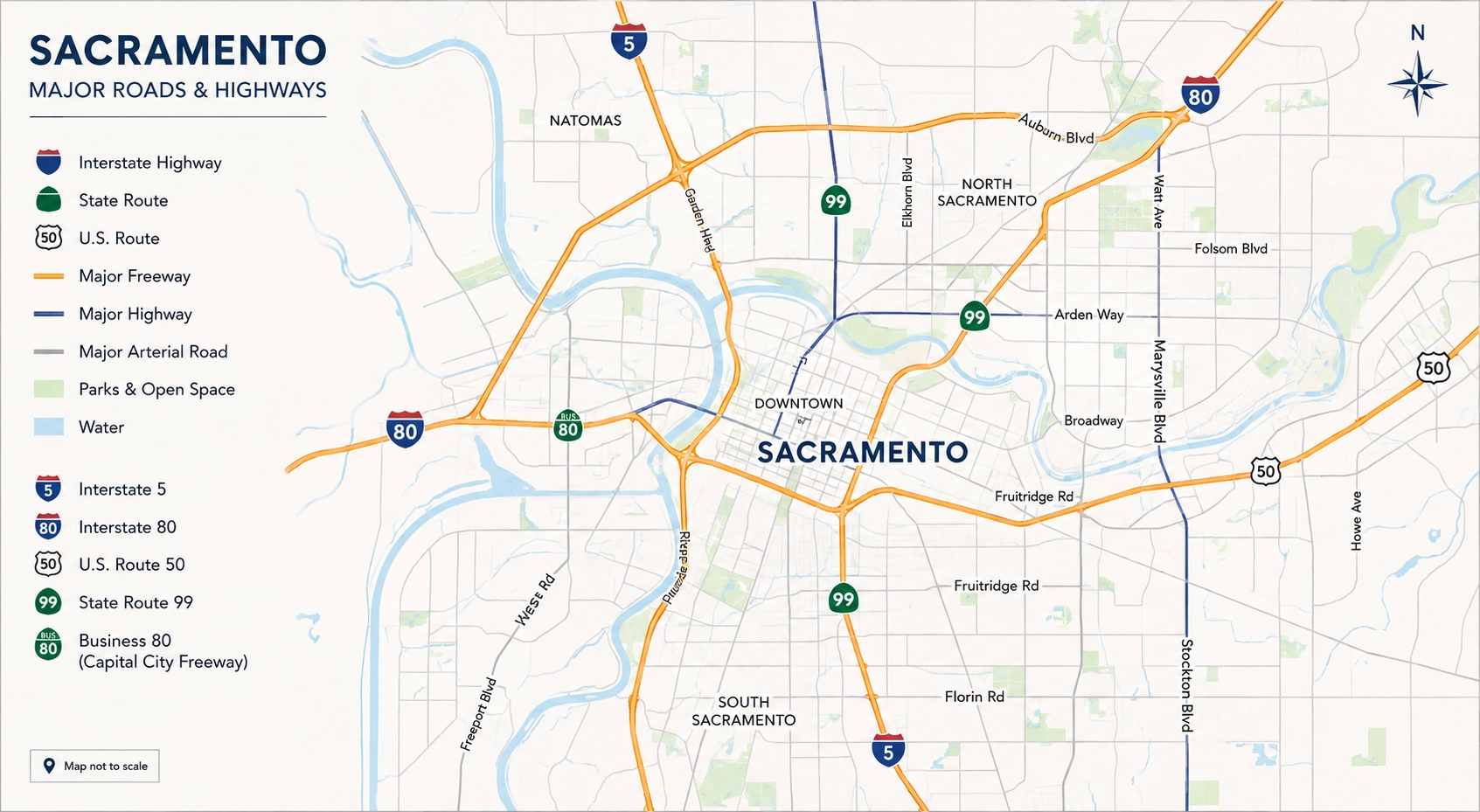
Downtown access, Natomas travel, regional freight, airport-area travel, merging, and multi-vehicle crashes
Regional traffic, Capital City Freeway connections, commuter travel, trucks, and interchange collisions
Downtown connections, east Sacramento travel, SR-99 connectors, commuter traffic, and freeway merging
South Sacramento travel, freight vehicles, Blue Line corridor access, and interchange traffic
Central Sacramento traffic, I-80 and US-50 connections, commuter vehicles, and urban freeway crashes
Vision Zero corridor with substantial pedestrian and severe-injury collision history
Vision Zero Top 5 corridor with pedestrian, bicycle, and vehicle safety projects
High Injury Network corridor through Oak Park with substantial daily vehicle traffic
High Injury Network corridor extending between Riverside Boulevard and Stockton Boulevard
Major arterial serving transit riders, pedestrians, businesses, neighborhoods, and the UC Davis Medical Center area
Caltrans identifies US-50 and the Capital City Freeway within the Sacramento highway system. Sacramento’s current Vision Zero work uses collision data to identify corridors with high concentrations of fatal and severe-injury crashes.
Marysville Boulevard recorded 19 fatal-or-severe-injury crashes within the studied segment from 2009–2017, including 11 pedestrian crashes, and had the largest pedestrian-crash share among Sacramento’s Vision Zero Top 5 corridor study.
Florin Road recorded 16 fatal-or-severe-injury crashes within its studied project limits from 2009–2017; 8 involved a person walking or bicycling.
Broadway carries approximately 15,000 vehicles per day through the Oak Park project area and sits on Sacramento’s Vision Zero High Injury Network.
Yes, qualifying Sacramento transit injury claims receive lawsuit-funding review when liability, compensable damages, attorney representation, and sufficient expected proceeds are present.
SacRT operates Blue, Gold, and Green light rail lines across the Sacramento region. Its network includes stations throughout the city and county.
Transit claims include:
Claims against SacRT or another public transportation entity involve government-claim procedures in addition to the underlying negligence analysis.
Yes, qualifying claims against California, Sacramento County, the City of Sacramento, SacRT, or another public entity receive funding review after the required government-claim procedures are addressed.
Sacramento presents a distinct public-entity claim context because the city contains state government offices, municipal property, county facilities, public transportation infrastructure, public streets, public parks, bridges, and government vehicles.
Public-entity claims include:
California normally requires an injury or personal-property administrative claim against a government agency within 6 months. A mailed denial normally starts a separate 6-month lawsuit filing period.
California’s $30,000/$60,000/$15,000 minimum auto liability limits affect the starting recovery pool in some Sacramento motor vehicle claims.
The table below shows the minimum liability amounts.
| California Auto Coverage | Minimum |
| Injury or death to 1 person | $30,000 |
| Injury or death to more than 1 person | $60,000 |
| Property damage | $15,000 |
California DMV confirms these minimum liability limits.
A Sacramento claim also receives review for other recovery sources, including commercial vehicle insurance, employer coverage, rideshare insurance, umbrella policies, excess coverage, uninsured motorist insurance, underinsured motorist insurance, public-entity recovery, and defendant assets.
California comparative fault reduces the expected legal recovery according to the plaintiff’s assigned percentage of responsibility, which also reduces the funding amount supported by the claim.
An example involving $200,000 in damages and 25% plaintiff fault leaves $150,000 before attorney fees, medical liens, litigation expenses, and lawsuit-funding repayment.
Mayfair Legal Funding evaluates the reduced expected recovery rather than the damages figure before fault allocation.
Yes, same-day Sacramento lawsuit loans are available when Mayfair Legal Funding receives sufficient claim information, completes the attorney-assisted review, approves the advance, and finishes the agreement early enough for same-day distribution.
Approved funding is delivered within 24 hours after completion.
Fast processing depends on accurate attorney contact information, responsive case communication, complete insurance details, disclosure of prior funding, and completed agreement documents.
Learn more about same-day settlement loans.
Sacramento lawsuit-loan pricing ranges from 2.5% to 5% per month in most cases, with the exact repayment terms established in the written agreement.
Pricing varies according to claim merit, complexity, expected resolution period, projected compensation, and underwriting risk.
The agreement identifies:
California law requires predetermined repayment amounts, prohibits repayment calculated as a percentage of the final recovery, prohibits prepayment penalties, and requires the contract to disclose the maximum repayment amount.
Yes, Sacramento lawsuit loans are legal when the transaction complies with California’s Consumer Legal Funding Act.
California Business and Professions Code §§6250–6256 regulate consumer legal funding agreements entered into under the Act beginning January 1, 2026.
The statutory protections include:
The funding transaction also cannot pay attorney fees, court costs, or filing fees.
A successful Sacramento claim repays the advance from case proceeds; an unsuccessful funded claim produces no ordinary repayment obligation.
A successful case follows this repayment sequence:
A lost claim with no financial recovery does not create monthly loan payments against the plaintiff’s salary, bank account, home, vehicle, or unrelated property.
Yes, Sacramento lawsuit loans are available near plaintiffs in Downtown, Midtown, the Railyards, Alkali Flat, Southside Park, Land Park, East Sacramento, Oak Park, Tahoe Park, and surrounding Central City neighborhoods.
Central Sacramento claims include vehicle collisions, pedestrian crashes, bicycle accidents, rideshare claims, light rail incidents, bus injuries, government-vehicle accidents, unsafe-property claims, construction injuries, restaurant accidents, and employment disputes.
Sacramento’s urban riverfront extends approximately 3.5 miles from Tiscornia Park near the Sacramento–American River confluence to Miller Park, adding pedestrian, bicycle, roadway, recreational, and waterfront property contexts to the central city.
Sacramento Valley Station and surrounding Railyards projects also combine commuter buses, rail passengers, bicycles, pedestrians, and vehicle traffic.
Yes, Sacramento lawsuit funding is available near plaintiffs in North Natomas, South Natomas, Arden-Arcade, Elk Grove, Pocket-Greenhaven, Del Paso Heights, North Sacramento, and surrounding Sacramento County communities.
Natomas sits near I-5, I-80, Downtown Sacramento, and Sacramento International Airport, producing a distinct mix of freeway, airport-access, commercial, residential, pedestrian, bicycle, and rideshare claim contexts.
Arden-Arcade is an unincorporated Sacramento County community rather than a Sacramento city neighborhood. Elk Grove is a separate incorporated city south of Sacramento.
Funding eligibility follows the legal claim rather than municipal boundaries.
California filing deadlines differ according to the claim type, defendant, and discovery circumstances.
The table below consolidates the primary filing rules relevant to Sacramento lawsuit-funding reviews.
2 years from the injury
2 years from the death
3 years from the damage
4 years from the breach
2 years from the breach
Earlier of 1 year after discovery or 3 years after injury, subject to exceptions
Written notice at least 90 days before filing
Administrative claim normally within 6 months
Lawsuit normally within 6 months after mailed denial
Deadline depends on when the injury or problem was discovered or reasonably should have been discovered
California Courts confirms the standard 2-year personal injury period, 3-year property damage period, 4-year written-contract period, and 2-year oral-contract period.
Medical malpractice uses the earlier of 1 year after actual or constructive discovery or 3 years after injury, subject to statutory exceptions, and requires at least 90 days’ notice before filing.
Delayed discovery does not create an automatic additional 1-year filing period for every injury discovered later. The applicable rule depends on the claim and facts.
A Sacramento plaintiff applies by submitting the pending claim, requested funding amount, and retained attorney information to Mayfair Legal Funding.
Mayfair Legal Funding obtains the authorized case information from the attorney, evaluates liability and expected compensation, determines the amount supported by the claim, issues the written terms, and distributes approved funding within 24 hours after completion.
Apply for MayFair Sacramento lawsuit funding Call (888) 357-1338
Mayfair Legal Funding provides lawsuit loans across California, including major metropolitan areas, suburban communities, inland cities, and coastal locations.
Mayfair funds plaintiffs in all 58 California counties. Pick a region to see some of the towns we serve.
Mayfair Legal Funding, LLC provides non-recourse cash advances structured as purchases of contingent interests in potential claim proceeds. References to “lawsuit loans,” “settlement loans,” or “pre-settlement loans” describe the service for marketing purposes. Mayfair Legal Funding does not provide conventional lending services. This page provides general information and does not provide legal, financial, or tax advice.